





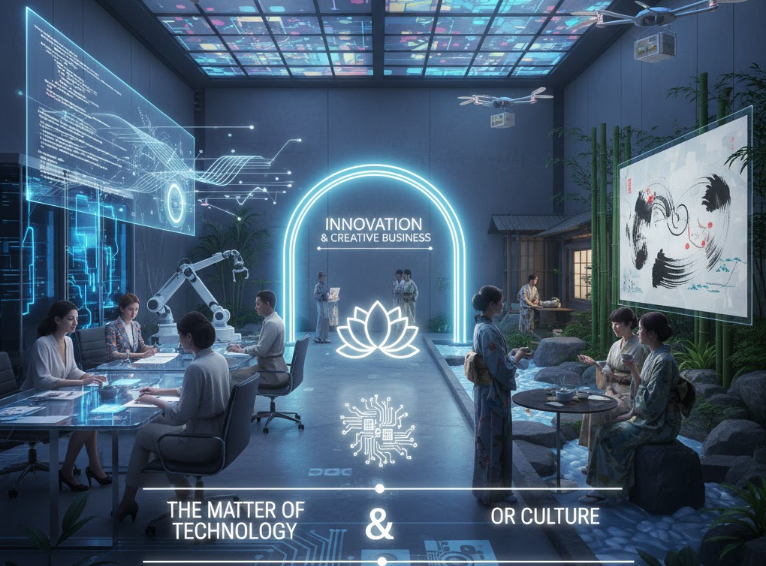
In today’s rapidly evolving marketplace, the mantra for success is clear: innovate or stagnate. But for many businesses striving for a competitive edge, a fundamental question emerges: Is the future of creative business primarily a matter of cutting-edge technology or a deeply embedded culture of innovation?
The truth, as often is the case, is not an either/or proposition. Instead, the most successful innovative and creative businesses master the delicate dance between technological advancement and a thriving, supportive culture.
The Allure of Technology: The Engine of Progress
There’s no denying the transformative power of technology. From artificial intelligence and automation to big data analytics and virtual reality, technological advancements offer unprecedented opportunities for businesses to:
- Streamline processes: AI-powered tools can automate repetitive tasks, freeing up human talent for more creative endeavors.
- Enhance customer experiences: Personalization driven by data analytics and immersive VR/AR experiences can create unforgettable interactions.
- Develop groundbreaking products and services: New technologies unlock possibilities that were once mere science fiction, leading to entirely new markets.
- Improve efficiency and reduce costs: Automation and sophisticated software can optimize operations, leading to significant savings.
Businesses that embrace and effectively leverage technology can gain a significant competitive advantage. They can move faster, learn more, and deliver more effectively. However, simply acquiring the latest tech gadgets isn’t enough.
The Power of Culture: The Soil for Innovation
Imagine planting a rare, advanced seed (technology) in barren soil (a poor company culture). It might sprout, but it’s unlikely to flourish or yield its full potential. This is where the profound importance of culture comes into play. A truly innovative and creative business culture is one that:
- Fosters psychological safety: Employees feel safe to experiment, take risks, and even fail without fear of punitive consequences. This encourages bold ideas.
- Promotes collaboration and open communication: Silos are broken down, and diverse perspectives are encouraged, leading to richer solutions.
- Values continuous learning and growth: Employees are encouraged to develop new skills, explore new ideas, and challenge the status quo.
- Embraces diversity and inclusion: Different backgrounds, experiences, and thought processes spark unique insights and broader creativity.
- Provides autonomy and empowerment: Employees are trusted to take ownership of their work and make decisions, leading to greater engagement and initiative.
- Celebrates creativity and rewards innovation: Recognition for innovative thinking reinforces the desired behaviors and motivates further exploration.
A strong culture acts as the fertile ground where technological seeds can truly take root, grow, and bear fruit. Without it, even the most advanced technology can be underutilized, misapplied, or simply ignored.
The Symbiotic Relationship: Technology and Culture
The most successful innovative and creative businesses don’t see technology and culture as competing forces, but as complementary partners.
- Technology can enable culture: Digital collaboration tools such as iNexx facilitate remote teamwork. Internal platforms can centralize knowledge sharing and idea submission. AI can personalize learning experiences for employees.
- Culture can drive technology adoption and optimization: An open-minded culture is more likely to embrace new technologies. A problem-solving culture will actively seek out technological solutions. A learning culture ensures that new tools are used to their fullest potential.
Consider companies like Google or Apple. While renowned for their technological prowess, their sustained innovation is deeply rooted in cultures that prioritize creativity, experimentation, and a relentless pursuit of improvement. They understand that the best technology is only as good as the people and processes that wield it.
Finding Your Balance between Technology and Culture
So, how does your business strike this crucial balance?
- Assess your current state: Honestly evaluate your technological infrastructure and your organizational culture. Where are your strengths? Where are your weaknesses?
- Define your innovation goals: What do you hope to achieve through innovation? Is it product development, operational efficiency, or customer experience?
- Invest strategically: Allocate resources to both technology upgrades and cultural initiatives like training, leadership development, and employee engagement programs.
- Lead by example: Leaders must embody the innovative spirit and champion both technological adoption and cultural values.
- Continuously adapt: Both technology and culture are dynamic. Regularly review and adjust your strategies to stay ahead.
Conclusion: The Future is a Blend of Tech and Culture in Creative Business
The debate between technology and culture in innovative and creative business isn’t a zero-sum game. The future belongs to those who understand that true breakthroughs emerge when cutting-edge tools are wielded by a workforce empowered by a culture of creativity, collaboration, and continuous learning. It’s not a matter of one or the other, but rather the harmonious integration of technology and culture that will propel businesses forward in the journey of innovation.
Ready to cultivate both technology and culture in your business? Contact iNexx for Collaboration Tools
Further Readings
